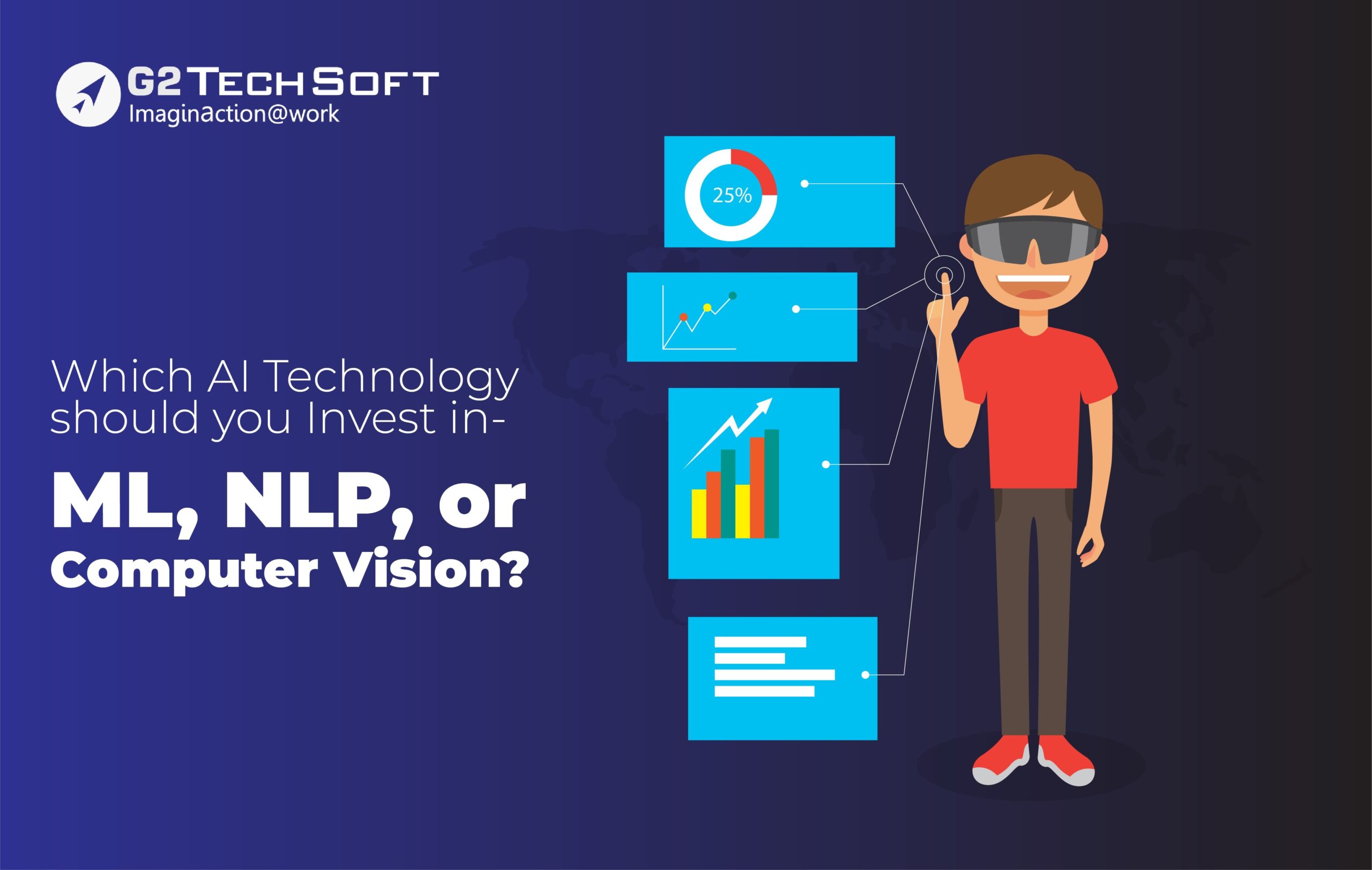
Which AI Technology Should You Invest In: ML, NLP, Or Computer Vision?
Introduction: The AI Investment Dilemma
Across industries in the US and Canada, organizations are embedding AI into their operations to boost efficiency, enhance customer experiences, and unlock new revenue streams. As part of broader digital transformation solutions, AI has become central to long-term business strategy.
However, decision-makers face a key challenge: which AI technology delivers the highest ROI? While the landscape is vast, enterprise adoption largely revolves around machine learning (ML), natural language processing (NLP), and computer vision. Understanding the differences between ML vs NLP vs computer vision is critical for making the right investment decision.
Ultimately, choosing the right AI capability isn’t about trends, it’s about aligning technology with real business impact. Organizations that focus on practical use cases and strategic execution will gain a clear competitive edge.
Understanding the Core AI Technologies
Machine Learning
ML involves algorithms that learn patterns from data and use those patterns to make predictions or decisions without being explicitly programmed.
ML systems improve over time as they process more data, making them highly valuable for dynamic environments. They can analyze large datasets, identify trends, and generate insights that support business decision-making.
Core capabilities of machine learning include forecasting, recommendation systems, anomaly detection, and predictive analytics. These capabilities enable organizations to optimize operations, reduce risks, and improve efficiency.
In the context of machine learning vs NLP vs computer vision, ML serves as the underlying engine that powers many AI applications. It is widely used across industries because of its versatility and scalability.
Natural Language Processing
NLP stresses permitting machines to actually understand and respond to human language. NLP serves as a link between computer comprehension and human communication.
NLP systems can analyze text and speech, extract meaning, and respond intelligently. This makes them highly valuable for customer-facing applications and automation.
Core capabilities of NLP include chatbots, sentiment analysis, document processing, and language translation. These applications are transforming how businesses interact with customers and manage large volumes of textual data.
NLP plays a critical role in improving customer experience and operational efficiency. It is particularly relevant for organizations dealing with high volumes of communication, such as customer support centers and digital platforms.
Computer Vision
Computer vision enables machines to interpret and analyze visual data, including images and videos. It allows systems to identify objects, detect patterns, and make decisions based on visual inputs.
This technology is transforming industries that rely heavily on visual data. From quality inspection in manufacturing to medical imaging in healthcare, computer vision is enabling new levels of automation and accuracy.
Core capabilities include object detection, facial recognition, image classification, and video analytics. These applications are driving innovation in sectors such as retail, security, and logistics.
Among the three technologies, computer vision often requires significant computational resources and large datasets, making it one of the more complex AI domains.
Key Differences Between ML, NLP, & Computer Vision
| Factor | Machine Learning | Natural Language Processing | Computer Vision |
| Data Type | Structured & unstructured data | Text and speech data | Images and video data |
| Core Function | Pattern recognition and predictions | Understanding and processing human language | Interpreting and analyzing visual data |
| Key Use Cases | Forecasting, recommendations, fraud detection | Chatbots, sentiment analysis, document parsing | Object detection, facial recognition |
| Complexity | Medium | Medium to high | High |
| Implementation | Relatively easier to deploy | Requires language models and training | Requires large datasets and computing |
| ROI Timeline | Medium-term | Short to medium-term | Medium to long-term |
| Industry Fit | Applicable across all industries | Customer-centric industries | Visual-heavy industries |
This comparison highlights the importance of aligning AI technology with business needs when defining an AI adoption strategy.
When Should you Invest in Machine Learning?
ML is the ideal choice when organizations need predictive insights and data-driven decision-making capabilities. It is particularly effective in scenarios where historical data can be used to forecast future outcomes.
Enterprises that aim to optimize operations, reduce costs, and improve efficiency can benefit significantly from ML. It enables organizations to identify patterns, detect anomalies, and make informed decisions in real time.
Common use cases include demand forecasting, fraud detection, and recommendation engines. For example, ML models can predict customer behavior, enabling personalized marketing strategies and improved customer engagement.
ML is also well-suited for organizations at the early stages of their AI journey. Its flexibility and relatively lower complexity make it easier to implement compared to other AI technologies.
For businesses seeking a strong foundation in AI, machine learning provides a practical starting point within a broader enterprise AI technologies framework.
When Should you Invest in NLP?
NLP is the right choice when organizations deal with large volumes of text or customer interactions. It is particularly valuable for automating communication and improving customer experience.
Businesses that rely on customer support, content management, or communication workflows can benefit greatly from NLP. It enables automation of repetitive tasks, reduces response times, and enhances service quality.
Common use cases include AI chatbots, virtual assistants, email processing, and sentiment analysis. These applications allow organizations to scale their operations while maintaining high levels of customer satisfaction.
NLP also plays a key role in extracting insights from unstructured data, such as customer feedback and social media content. This helps organizations understand customer sentiment and make data-driven decisions.
For enterprises focused on customer engagement and operational efficiency, NLP is a critical component of their AI investment strategy.
When Should you Invest in Computer Vision?
Computer vision is best suited for organizations that rely on visual data. It enables automation in processes that involve inspection, monitoring, and recognition.
Industries such as manufacturing, healthcare, and retail can benefit significantly from computer vision. It allows for real-time analysis of images and videos, improving accuracy and efficiency.
Common use cases include quality control in manufacturing, medical imaging analysis, and retail analytics. For example, computer vision can detect defects in products, analyze medical scans, and monitor customer behavior in stores.
While computer vision requires higher investment and infrastructure, it offers substantial long-term value. It is particularly effective in environments where visual data plays a critical role.
For organizations with image- or video-heavy workflows, computer vision is a key driver of innovation.
Cost, Complexity, & ROI Comparison
ML typically involves moderate costs and is relatively easier to implement. It offers faster ROI due to its wide range of applications and scalability.
NLP requires moderate to high investment, particularly for advanced language models. However, it delivers high ROI by automating communication and improving customer experience.
Computer vision involves higher costs due to infrastructure requirements and data complexity. While implementation can be challenging, it offers significant long-term ROI in industries that rely on visual data.
Understanding these differences is essential for conducting an effective AI ROI comparison and making informed investment decisions.
The Hybrid Approach: Combining AI Technologies
Most enterprises do not rely on a single AI technology. Instead, they adopt a hybrid approach that combines multiple capabilities to maximize value.
For example, combining ML and NLP enables intelligent chatbots that can predict user behavior and provide personalized responses. Integrating ML with computer vision allows for advanced analytics in surveillance systems.
NLP and computer vision can also be combined to create multimodal AI applications that process both text and visual data.
The future of AI lies in these integrated systems. Multimodal AI solutions are becoming increasingly popular, enabling organizations to leverage multiple data types and deliver more comprehensive insights.
Decision Framework: How to Choose the Right AI Investment
- Define business objectives: Identify the exact problem you want AI to solve.
- Assess your data: Determine whether you have structured data, text, or images/video.
- Map use cases to AI type: Align ML, NLP, or Computer Vision with your needs.
- Evaluate internal capabilities: Check your team’s skills, tools, and infrastructure readiness.
- Estimate budget and ROI: Compare investment vs expected business impact.
- Start with a pilot project: Test on a small scale before full deployment.
- Measure performance: Track results using clear KPIs and outcomes.
- Scale strategically: Expand only after proven ROI and operational success.
Industry-Wise AI Investment Recommendations
Different industries benefit from different AI technologies.
- Finance organizations often rely on ML for fraud detection and risk analysis.
- Healthcare combines computer vision and NLP for medical imaging and patient data analysis.
- Retail leverages NLP for customer experience and ML for recommendation systems.
- Manufacturing uses computer vision for quality control and automation.
- SaaS and IT companies adopt NLP and ML for automation and analytics.
Future Outlook: AI Investment Trends in 2026 and Beyond
- Multimodal AI systems are gaining traction, combining ML, NLP, and computer vision to deliver comprehensive solutions.
- Generative AI is expanding the capabilities of NLP, enabling advanced content creation and automation.
- Edge AI is driving innovation in computer vision, enabling real-time processing at the device level.
- Organizations are increasingly adopting AI-first strategies, integrating AI into core business operations.
Access to top artificial intelligence experts and advanced tools will play a critical role in shaping these trends.
Conclusion: Invest Based on Value, Not Hype
ML, NLP, and computer vision each offer unique advantages and serve different purposes. The key is to align AI investments with real-world use cases and measurable outcomes.
Organizations that focus on value rather than hype will achieve the greatest success. By adopting a strategic approach to AI investment, enterprises can unlock innovation, drive efficiency, and gain a competitive edge in the evolving digital landscape.
In the end, the question is not just which AI technology to choose, but how effectively it can be integrated into the broader vision of business transformation.