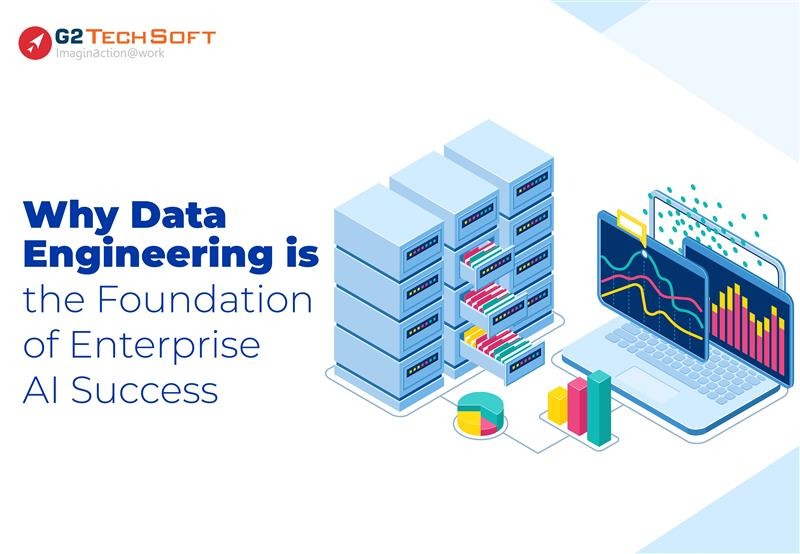
Why Data Engineering is the Foundation of Enterprise AI Success
Introduction: The Hidden Engine Behind Enterprise AI
From predictive analytics to intelligent automation, the promise of AI is reshaping how enterprises operate. Despite the surge in AI adoption, a large share of AI projects fail to deliver expected outcomes. Many organizations struggle to move beyond pilot phases, while others face challenges in scaling AI solutions effectively. The root cause is often misunderstood.
The problem is not the lack of advanced algorithms or sophisticated models. Instead, it lies in the underlying data infrastructure. Without reliable, high-quality, and scalable data systems, even the most advanced AI models cannot function effectively.
This is where data engineering for AI becomes critical. Data engineering is the backbone of enterprise AI, ensuring data is collected, processed, and delivered to support intelligent decision-making. It transforms raw, fragmented data into structured, actionable insights.
In essence, enterprise data engineering is the hidden engine that powers AI success. Organizations that invest in robust data engineering capabilities are better positioned to build scalable, reliable, and impactful AI solutions.
Understanding The Role Of Data Engineering In AI Ecosystems
Data engineering is the discipline of designing, building, and maintaining systems that enable the collection, storage, and processing of data at scale. In modern enterprises, it plays a foundational role in supporting AI and machine learning workflows.
At its core, data engineering ensures that data is accessible, reliable, and ready for analysis. It bridges the gap between raw data sources and AI models, enabling seamless data flow across the organization.
Several key components define AI data infrastructure:
Data Pipelines
Data pipelines automate the ingestion, transformation, and movement of data from multiple sources into centralized systems. These pipelines ensure that data is continuously updated and available for AI applications.
Data Lakes And Warehouses
Modern data platforms store large volumes of structured and unstructured data. Data lakes provide flexibility for storing raw data, while data warehouses enable structured querying and analytics.
Data Integration
Enterprises often operate multiple systems—CRM, ERP, IoT devices, and third-party applications. Data integration combines these disparate sources into a unified view, enabling consistent analysis.
Data Governance
Governance frameworks ensure data quality, security, and compliance. They define policies for data access, usage, and management, which are essential for enterprise-scale AI deployment.
Why AI Fails Without Strong Data Engineering
Despite significant investments in AI, many initiatives fail due to weak data foundations. Several critical challenges highlight why data engineering is important for AI.
Poor Data Quality
AI models rely on data for training and decision-making. Incomplete, inconsistent, or biased datasets can lead to inaccurate predictions and unreliable outcomes. Poor data quality undermines model performance and erodes trust in AI systems.
Fragmented Data Sources
Data is often distributed across multiple systems, departments, and formats. Without proper integration, AI models cannot access a complete view of the data, limiting their effectiveness.
Lack of Real-Time Data Pipelines
Many organizations rely on batch processing, resulting in delayed insights. In fast-paced environments, outdated data can lead to missed opportunities and suboptimal decisions.
Weak Data Governance
Without strong governance, organizations face compliance risks, data breaches, and inconsistent data usage. Governance gaps can hinder AI adoption and scalability.
These challenges demonstrate that AI success depends not just on models, but on the quality and reliability of the underlying enterprise data pipelines.
The Core Pillars Of Data Engineering For Enterprise AI
To support AI initiatives effectively, organizations must build strong data engineering foundations based on four key pillars.
Scalable Data Architecture
Modern enterprises require scalable data systems capable of handling large volumes of structured and unstructured data. Cloud-based storage solutions and data lakes enable organizations to store and process data efficiently.
A well-designed AI-ready data architecture ensures flexibility, scalability, and performance, supporting growing data demands.
Reliable Data Pipelines
Automated data pipelines are essential for continuous data flow. These pipelines handle data ingestion, transformation, and processing, ensuring that AI systems receive accurate and up-to-date information.
Real-time pipelines further enhance responsiveness, enabling organizations to act on insights immediately.
Data Quality And Governance
Data validation frameworks ensure that data meets quality standards. Governance policies enforce compliance with regulations, protect sensitive information, and maintain consistency across systems.
Strong governance is critical for building trust in AI systems.
Data Accessibility And Democratization
Data should be accessible to AI teams, analysts, and decision-makers. Democratizing data access enables collaboration and accelerates innovation.
By providing reliable datasets across teams, organizations can unlock the full potential of data engineering for machine learning.
How Data Engineering Powers Enterprise AI Applications
Data engineering is the foundation for a wide range of AI applications.
Predictive analytics and forecasting rely on historical and real-time data to identify trends and predict outcomes. Without reliable pipelines, these models cannot function effectively.
AI-powered customer insights require integrated data from multiple touchpoints to deliver personalized experiences.
Fraud detection and risk management systems depend on real-time data processing to identify anomalies and prevent losses.
Recommendation systems use large datasets to provide personalized suggestions, enhancing user engagement.
Intelligent automation relies on structured data to streamline workflows and improve efficiency.
In all these cases, enterprise data engineering ensures that data is available, accurate, and actionable. Without strong data pipelines, these AI systems would fail to deliver value.
Benefits Of Strong Data Engineering For Enterprise AI
Faster AI Model Development
Reliable datasets reduce the time required for data preparation, enabling faster model training and deployment. Data engineers streamline workflows, allowing data scientists to focus on model development.
Improved AI Accuracy
High-quality data leads to better model performance. Accurate and consistent datasets enhance prediction accuracy and reduce errors.
Scalable AI Deployment
Robust data infrastructure supports large-scale AI workloads. Organizations can deploy models across multiple applications and geographies without performance issues.
Better Business Insights
Real-time analytics enable organizations to make informed decisions quickly. Data-driven insights improve operational efficiency and strategic planning.
These benefits highlight the critical role of modern data platforms in enabling enterprise AI success.
Key Challenges In Building Enterprise Data Engineering Systems
Despite its importance, building data engineering systems presents several challenges.
Data silos across departments create integration difficulties, limiting data accessibility.
Complex data integration requires sophisticated tools and expertise, increasing implementation complexity.
There is a growing talent shortage in data engineering, making it difficult for organizations to build skilled teams.
Infrastructure costs can be high, especially for large-scale data processing and storage.
Maintaining data security and compliance adds another layer of complexity, particularly in regulated industries.
Addressing these challenges is essential for unlocking the full potential of AI.
Modern Data Engineering Technologies Supporting AI
Several technologies are driving advancements in data engineering.
Cloud data platforms provide scalable infrastructure for storing and processing data.
Data lakes and lakehouse architectures combine flexibility with performance, supporting diverse data types.
Real-time streaming pipelines enable continuous data processing and immediate insights.
AI-ready analytics platforms integrate data engineering with advanced analytics capabilities.
Data observability and monitoring tools ensure data quality and system reliability.
These technologies form the backbone of AI data infrastructure, enabling organizations to build robust data ecosystems.
Building An AI-Ready Data Engineering Strategy
Organizations must adopt a structured approach to building data engineering capabilities.
First, assess the current data infrastructure to identify gaps and opportunities.
Next, establish a centralized data architecture that supports scalability and integration.
Implement automated data pipelines to ensure continuous data flow.
Adopt strong governance frameworks to maintain data quality and compliance.
Finally, enable cross-team data accessibility to foster collaboration and innovation.
A well-defined data engineering strategy ensures that AI initiatives are supported by reliable and scalable data systems.
Future Outlook: Data Engineering In The AI-Driven Enterprise
Looking ahead, data engineering will become a strategic priority for enterprises.
AI-driven data pipelines will automate data management processes, reducing manual intervention.
Real-time analytics will enable intelligent decision-making across business functions.
Organizations will invest heavily in AI-ready data architectures to support advanced AI applications.
As artificial intelligence continues to evolve, data engineering will play an increasingly critical role in shaping enterprise capabilities.
Access to top artificial intelligence experts and advanced tools will further accelerate innovation.
Conclusion: No AI Success Without Data Engineering
Enterprise AI success is not driven solely by algorithms or machine learning models. The true differentiator lies in the strength of the underlying data infrastructure.
Data engineering provides the foundation that enables AI systems to operate effectively. It ensures that data is reliable, accessible, and scalable, transforming raw information into actionable insights.
Organizations that invest in enterprise data engineering will unlock the full potential of AI, gaining a competitive edge in the data-driven economy.
As part of broader digital transformation solutions, data engineering is not just a technical function; it is a strategic capability that defines the future of intelligent enterprises.