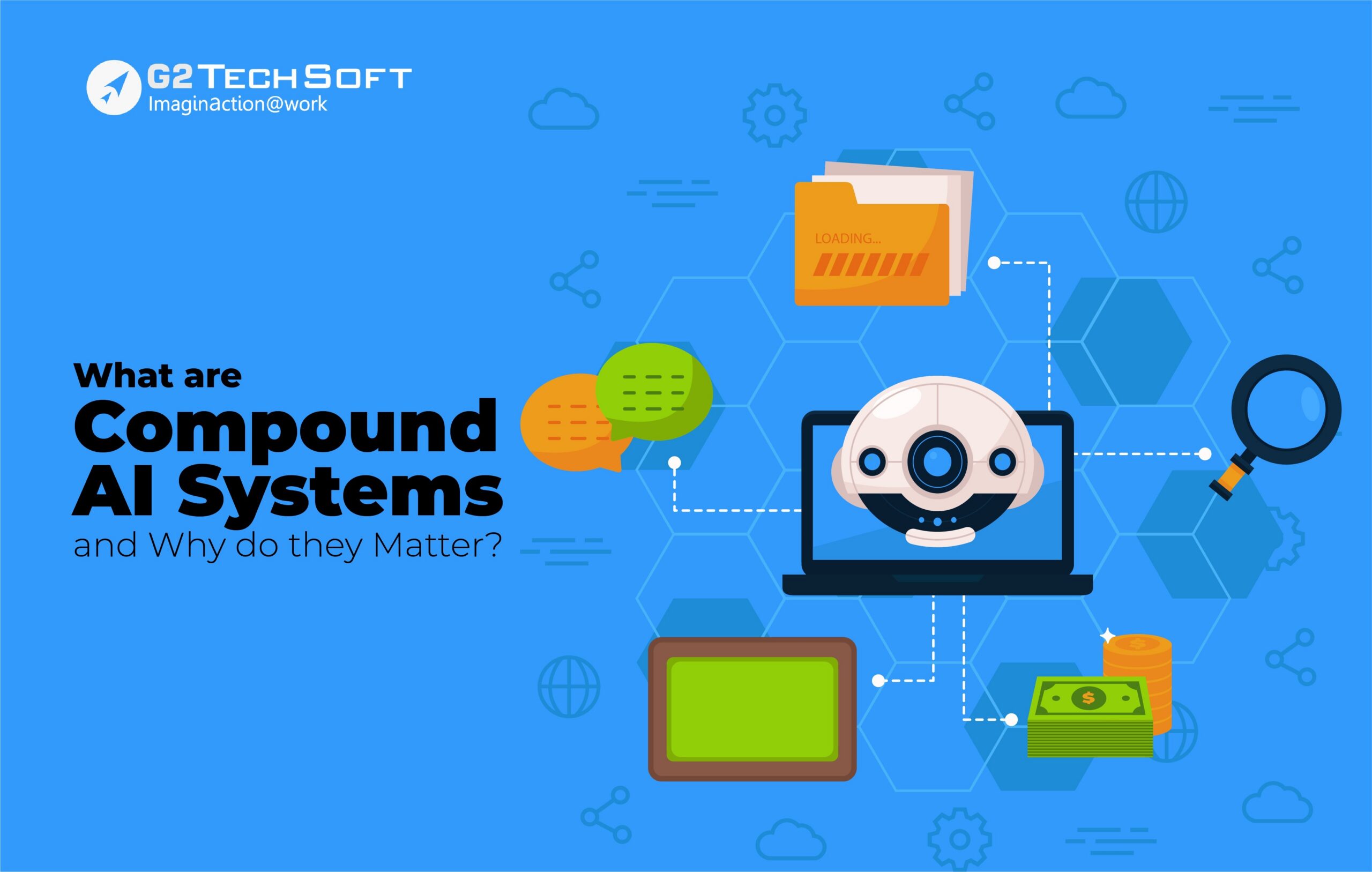
What are Compound AI Systems and Why do they Matter?
Introduction: The Evolution beyond Single-Model AI
AI has developed from discrete, task-specific models to intelligent systems that can handle progressively challenging commercial issues. While early AI programs were great at certain tasks, like text production and picture recognition, they frequently encountered trouble with workflows involving many decision points, contextual knowledge, and connection with other systems.
Data is dispersed over databases, cloud platforms, business apps, and APIs in current data-rich settings. Addressing such challenges demands AI systems that is able to reason, retrieve data/information, execute workflows and create contextual responses instead of depending on a single model.
This evolution has led to compound AI systems, an advanced AI system architecture that combines multiple AI models, tools, databases, and orchestration layers into a unified ecosystem. Compound AI systems are becoming the basis for scalable, enterprise-ready AI as businesses continue to invest in AI and digital transformation solutions.
What are Compound AI Systems?
Compound AI systems are intelligent architectures made up of several AI models, business tools, processes, and auxiliary technologies that collaborate to achieve challenging goals. Instead of solely depending on a single model to perform each task, these systems will allocate responsibilities to specialized components that will collaborate throughout the workflow.
Large Language Models (LLMs), business logic, APIs, vector databases, and orchestration frameworks are all common components of compound AI systems. While the language model provides reasoning and natural language understanding, APIs retrieve live information, databases supply enterprise knowledge, and orchestration layers coordinate communication between every component.
Multi-model AI systems, in contrast to solo models, are capable of multi-step reasoning, real-time information access, workflow automation, and more accurate outputs. This modular design makes them highly adaptable, allowing organizations to expand AI capabilities without redesigning the entire architecture.
Key Components of Compound AI Systems
Large Language Models (LLMs)
LLMs serve as the reasoning engine of compound AI systems. They interpret user intent, understand natural language, summarize information, and generate responses. To provide more contextual and dependable outcomes, they work with external tools and business knowledge sources rather than working alone.
Tools and APIs
External APIs extend AI beyond language generation by connecting it with CRM platforms, ERP systems, search engines, analytics platforms, and cloud applications. These integrations enable AI to retrieve live business data, automate actions, and support real-world decision-making.
Memory and Context Layers
Memory layers preserve conversation history, user preferences, and contextual information across interactions. This enables AI systems to provide personalized responses while maintaining continuity during extended workflows.
Orchestration Layer
The orchestration layer coordinates every component within the system. It determines which model, API, or database should be used for each task and manages the sequence of execution. Effective AI orchestration ensures smooth collaboration between multiple technologies.
Data Systems
Modern compound AI systems purely depend on vector databases and structured databases for semantic retrieval. These knowledge sources provide current, relevant, and contextual information, allowing AI to generate responses based on live enterprise data rather than static training information.
How Compound AI Systems Work
Compound AI systems complete tasks through coordinated workflows rather than single predictions. The process typically follows several stages.
A user first submits a request, which the language model analyzes to determine intent. The orchestration layer then identifies which knowledge sources or business applications are needed. Semantic search retrieves relevant information from enterprise databases, while APIs gather real-time data or perform required actions. Finally, the LLM combines the collected information and generates a complete response.
Compound AI systems produce richer, more precise, and context-aware outcomes than typical AI models because several specialized components work together throughout the workflow.
Why Single-Model AI is not Enough
Although standalone AI models remain valuable for individual tasks, they face significant limitations in enterprise environments.
They typically struggle with maintaining long-term context, lack direct access to real-time enterprise information, and cannot independently execute complex workflows involving multiple systems. Their responses are often limited by static training data, reducing their effectiveness in rapidly changing business environments.
Compound AI systems overcome these limitations by integrating multiple technologies into a unified architecture capable of reasoning, retrieving current information, and executing business workflows dynamically.
Why Compound AI Systems Matter
Enable Complex Problem Solving
Modern business processes often involve numerous interconnected steps requiring data retrieval, reasoning, and workflow automation. Compound AI systems distribute these responsibilities across specialized components, enabling them to solve sophisticated enterprise problems more effectively.
Improve Accuracy and Reliability
By combining multiple trusted data sources instead of relying solely on model knowledge, compound AI systems produce more reliable outputs. Business rules, external databases, and APIs all aid in response validation and error reduction.
Real-Time Data Integration
Unlike standalone models, compound AI systems continuously retrieve current information from enterprise platforms, ensuring responses remain relevant and aligned with changing business conditions.
Scalability and Flexibility
Their modular architecture allows organizations to upgrade or replace individual components without rebuilding the entire system. This flexibility supports continuous innovation and future technology adoption.
Enhanced User Experience
AI may produce more individualized, thorough, and useful solutions through the combination of contextual memory, semantic retrieval, and process automation.
Real-World Use Cases
Compound AI systems support a wide range of enterprise applications.
Enterprise AI copilots combine language models with internal knowledge bases and productivity tools to assist employees with research, documentation, and decision-making.
Customer support platforms integrate conversational AI with CRM systems and historical customer interactions to deliver context-aware assistance.
Financial services use compound AI systems to combine market data, analytics, and forecasting models for investment research and fraud detection.
In healthcare, AI integrates medical literature, patient records, and clinical guidelines to support informed decision-making.
Supply chain platforms combine forecasting models, inventory systems, logistics data, and market information to improve operational planning and resource allocation.
Benefits For Enterprises
Compound AI systems deliver significant business value by improving both operational efficiency and decision-making.
They enable faster decisions through automated information gathering and intelligent reasoning while reducing manual effort across business workflows.
Organizations also benefit from improved AI performance because responses are supported by contextual knowledge, live data, and specialized reasoning components.
Their modular architecture encourages innovation by allowing businesses to integrate new AI capabilities without disrupting existing systems. At the same time, workflow automation reduces operational costs and increases productivity across departments.
Challenges in Building Compound AI Systems
Despite their advantages, compound AI systems introduce several implementation challenges.
System complexity increases as organizations manage multiple models, APIs, databases, and orchestration frameworks.
Integration challenges arise when connecting legacy enterprise systems with modern AI platforms.
Latency may increase because multiple processing steps occur before generating responses, requiring careful workflow optimization.
Organizations must also address governance and security by protecting sensitive information, enforcing access controls, and maintaining regulatory compliance.
Finally, monitoring and observability become essential for tracking data quality, workflow execution, and overall system performance across interconnected AI components.
Best Practices for Implementing Compound AI Systems
Organizations should begin with clearly defined business use cases before expanding AI initiatives across the enterprise.
Adopting modular and scalable architectures makes future enhancements easier while reducing implementation risks. Strong orchestration frameworks help coordinate workflows efficiently, and robust data pipelines ensure reliable, high-quality information is available throughout the AI lifecycle.
Continuous monitoring, workflow optimization, and security governance should remain integral components of every compound AI deployment.
Role Of Emerging Technologies
Several emerging technologies are accelerating the adoption of compound AI systems.
AI agents are enabling increasingly autonomous workflow execution, while vector databases improve semantic search by retrieving information based on contextual meaning.
Retrieval-Augmented Generation (RAG) combines language models with external knowledge sources to improve factual accuracy and contextual understanding.
Additionally, MLOps and AI observability platforms provide continuous monitoring, helping organizations maintain reliable and scalable AI workflows.
Future Trends in Compound AI Systems
Enterprise AI is steadily moving toward autonomous, interconnected ecosystems. AI agents will increasingly coordinate complex workflows, while standardized orchestration frameworks will simplify enterprise adoption.
Greater integration between AI and business process automation will create more adaptive and intelligent operations. Over time, compound AI systems are expected to evolve into self-improving ecosystems capable of learning continuously from operational feedback while supporting increasingly sophisticated enterprise use cases.
Conclusion
Compound AI systems represent the next evolution of AI system architecture, enabling organizations to move beyond the limitations of standalone models. By combining language models, enterprise data, APIs, orchestration frameworks, and intelligent workflows, these systems deliver more accurate, scalable, and context-aware AI capabilities.
As businesses continue investing in Artificial Intelligence, AI orchestration, and Digital Transformation Solutions, compound AI systems will become a key enabler of enterprise innovation. Organizations that adopt this architecture today will be better positioned to build intelligent, adaptable, and future-ready AI ecosystems that deliver lasting business value.