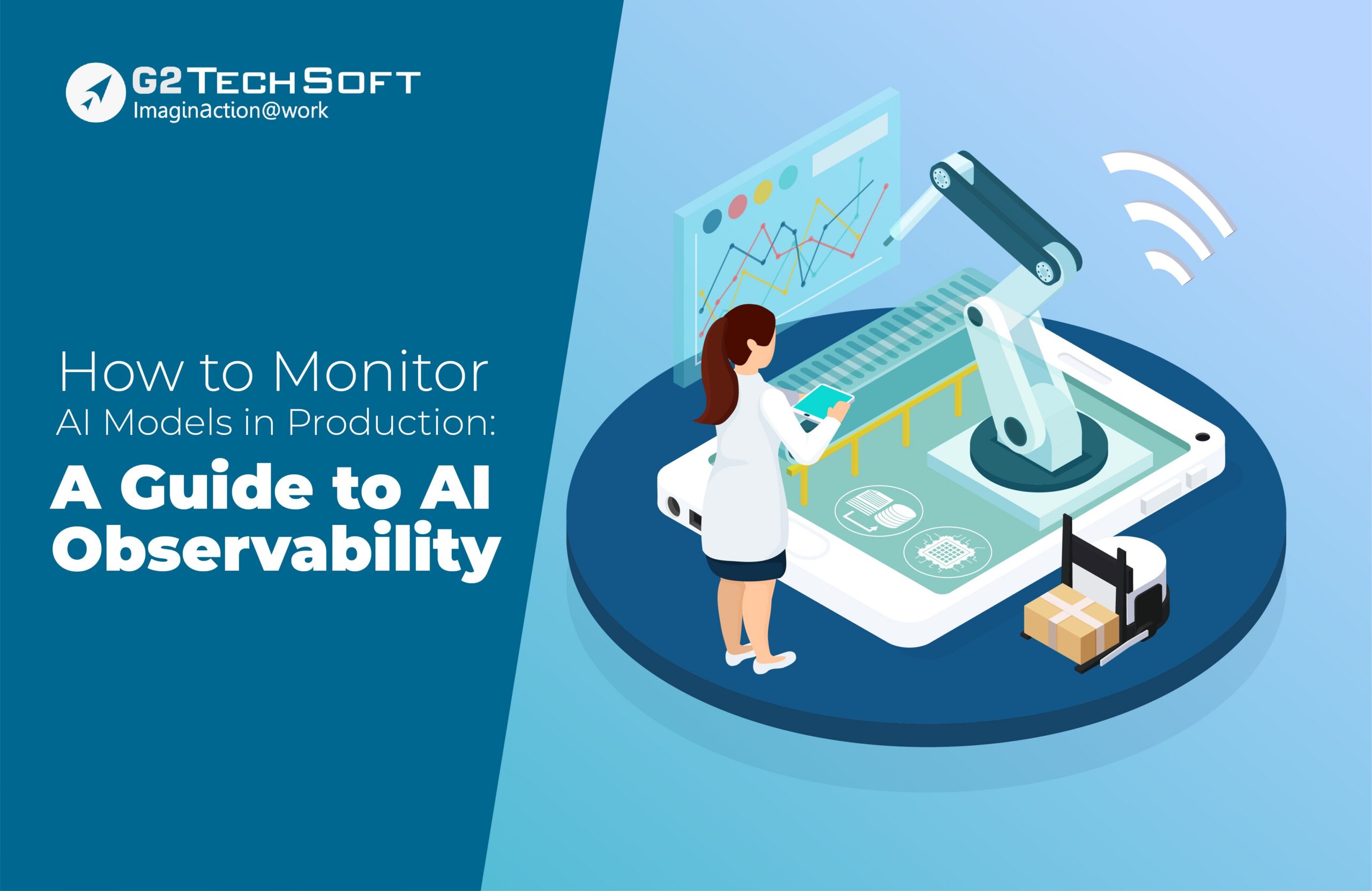
How to Monitor AI Models in Production-A Guide to AI Observability
Introduction: Why Monitoring AI in Production is Critical
Deploying an AI model into production is not the end of its lifecycle; it is the beginning of a continuous process of monitoring, optimization, and improvement. Unlike traditional software applications, AI models operate in dynamic environments where data patterns, user behavior, and business conditions constantly evolve. As these changes occur, model performance can gradually decline, leading to inaccurate predictions, biased outcomes, and poor business decisions.
Challenges such as model drift, performance degradation, and data quality issues cannot be detected through conventional IT monitoring tools alone. While traditional monitoring focuses on infrastructure health, AI systems require visibility into data quality, prediction accuracy, and model behaviour. This has led to the emergence of AI observability as a critical discipline for managing AI in production.
Organizations investing in Artificial Intelligence and Digital Transformation Solutions increasingly recognize that monitoring AI models is essential for maintaining reliability, trust, and long-term business value.
What Is AI Observability?
AI observability is the practice of monitoring, analysing, and understanding the behaviour of AI models after they have been deployed into production. Its objective is to ensure that models continue to produce accurate, reliable, and fair predictions even as data and business environments change over time.
Unlike traditional monitoring systems that focus only on server health or application availability, AI observability extends across the entire AI lifecycle. It includes monitoring input data, evaluating model performance, analysing prediction quality, and detecting unexpected changes that may affect outcomes.
A comprehensive AI model monitoring strategy provides organizations with visibility into how models behave under real-world conditions. It enables teams to identify problems early, understand their root causes, and take corrective action before business operations are affected.
Ultimately, AI observability helps organizations build trustworthy AI systems that deliver consistent performance while supporting governance, compliance, and continuous improvement.
Why Traditional Monitoring Falls Short for AI
Conventional monitoring frameworks focus primarily on infrastructure, tracking metrics such as CPU usage, memory consumption, and system uptime. These are necessary but insufficient for AI systems, since they lack visibility into data quality and model performance.
A model can be technically “healthy” from an infrastructure standpoint, running without crashes or downtime, while quietly producing inaccurate or biased predictions. Traditional tools simply cannot detect issues like:
- Data drift
- Concept drift
- Prediction anomalies
This blind spot is precisely the gap that dedicated observability practices are designed to close. A system dashboard showing green across every infrastructure metric offers no reassurance that the model behind it is still making sound decisions, which is why observability has emerged as a parallel discipline, sitting alongside rather than replacing traditional infrastructure monitoring.
Key Components Of AI Observability
A comprehensive observability strategy is typically built around several interconnected components.
Data Monitoring
Data monitoring focuses on tracking input data quality and distribution over time. It helps detect missing values, anomalies, and drift before they can influence downstream predictions.
Model Performance Monitoring
Model performance monitoring tracks accuracy, precision, and recall, allowing teams to identify performance degradation as it develops over time rather than after the fact.
Prediction Monitoring
Prediction monitoring analyzes outputs for anomalies or bias, while also tracking prediction confidence levels to understand how certain a model is about its own decisions.
Drift Detection
Drift detection is a central pillar of observability and includes two related but distinct concepts.
Data Drift is nothing but the changes in the distribution of input data.
Concept Drift describes changes in the underlying relationship between inputs and outputs.
Both forms of model drift detection are essential for catching problems before they affect real-world outcomes.
Explainability And Transparency
Explainability and transparency involve understanding how models make decisions, supported by tools for interpreting predictions in a way that is meaningful to both technical and non-technical stakeholders.
AI Observability Architecture
A well-designed observability architecture generally rests on four layers.
Data Pipeline Monitoring
This layer ensures clean and consistent data flow into the model, forming the foundation upon which every other layer depends.
Logging Layer
The logging layer receives metadata, outputs, and inputs, making a detailed record that will help with later analysis and troubleshooting.
Monitoring Layer
The monitoring layer provides real-time dashboards and alerts, allowing issues to be identified as they emerge rather than after they have caused harm.
Feedback Loop
The feedback loop closes the cycle, enabling continuous model retraining and improvement based on insights gathered from the layers above. Together, these layers form the backbone of effective MLOps monitoring.
Key Metrics To Track
Successful AI in production requires continuous measurement of meaningful performance indicators rather than relying solely on infrastructure metrics.
Organizations should regularly monitor model accuracy, error rates, precision, and recall to evaluate prediction quality. Data drift metrics such as Population Stability Index (PSI) and KL Divergence help identify changing data distributions before they affect performance.
Operational metrics including response latency and processing time ensure models continue meeting application performance requirements.
Prediction confidence scores provide additional insight into model certainty, while bias and fairness metrics help organizations identify unintended discrimination or inconsistent decision-making.
Monitoring these metrics collectively provides a comprehensive understanding of model health and operational reliability.
Tools And Technologies For AI Observability
The ecosystem supporting observability spans both open-source and enterprise monitoring tools.
Many organizations rely on dedicated model monitoring platforms that integrate directly with existing MLOps pipelines, allowing observability to become a natural extension of the deployment process rather than an afterthought. Cloud-native AI monitoring solutions have also emerged, offering scalable ways to track models running across distributed infrastructure, often designed to work seamlessly with the containerized and microservice-based architectures that many production AI systems now rely on.
The right combination of tools for AI model monitoring depends heavily on an organization’s scale, industry, and regulatory environment. A small team running a single model may find a lightweight open-source solution sufficient, while a large enterprise operating dozens of models across multiple business units typically needs a more centralized platform capable of standardizing monitoring practices across the organization.
Benefits Of AI Observability
Implementing AI observability delivers significant long-term benefits for organizations deploying AI at scale.
Continuous monitoring improves model reliability by detecting issues before they impact business outcomes. Early identification of drift, anomalies, or declining performance reduces operational risk and minimizes costly prediction errors.
Organizations also benefit from faster issue resolution because observability provides clear visibility into the root causes of model failures. This reduces troubleshooting time and improves operational efficiency.
From a governance perspective, AI observability strengthens compliance by supporting transparency, auditability, and responsible AI practices. Monitoring also increases stakeholder confidence by demonstrating that AI systems are continuously evaluated and improved.
Most importantly, observability enables continuous optimization, ensuring AI models remain accurate and aligned with evolving business requirements.
Challenges in Monitoring AI Models
Despite its clear value, implementing observability is not without difficulty.
Handling Large-Scale Data
The high volume of real-time data flowing through modern AI systems presents a genuine challenge for consistent monitoring.
Defining Meaningful Metrics
Choosing the right KPIs requires a deep understanding of both the business context and the model’s intended purpose.
Managing Model Complexity
Complex models are harder to interpret, which can make observability efforts more demanding as sophistication increases.
Ensuring Privacy and Compliance
Protecting sensitive data remains a persistent concern, particularly when observability practices involve logging and analyzing information tied to real users.
Best Practices For AI Observability
Organizations that succeed with observability tend to follow a consistent set of principles:
- Implement monitoring from day one
- Use automated alerts for anomalies
- Track both data and model metrics
- Establish feedback loops for retraining
- Combine observability with MLOps practices
- Ensure explainability for decision-making
Real-World Use Cases
The practical value of observability becomes clear when looking at how it is applied across industries:
- Fraud detection systems monitoring anomalies
- Recommendation engines tracking relevance
- Healthcare AI ensuring diagnostic accuracy
- Financial models monitoring risk predictions
Future Trends in AI Observability
Looking ahead, the field of AI observability is poised for significant evolution:
- Integration with AIOps and MLOps platforms
- Rise of self-healing AI systems
- Greater focus on AI governance and compliance
- Advanced explainability techniques
- Real-time adaptive AI monitoring
Conclusion: Building Trustworthy AI Systems
As organizations increasingly rely on AI to support critical business decisions, deployment alone is no longer sufficient. Continuous monitoring is essential for ensuring models remain accurate, reliable, and aligned with changing real-world conditions.
By combining data monitoring, performance tracking, drift detection, explainability, and continuous feedback, AI observability enables organizations to build trustworthy AI systems that deliver long-term value. Following best practices for AI observability and adopting appropriate tools for AI model monitoring allows businesses to manage risk while improving operational performance.
For enterprises embracing Artificial Intelligence as part of their Digital Transformation Solutions, investing in robust AI observability is no longer optional; it is a fundamental requirement for building resilient, transparent, and scalable AI systems in production.